
Ultherapy at an Apgujeong Rodeo Station Dermatology Clinic: Why Depth Varies by Area
For those looking into Ultherapy PRIME at an Apgujeong Rodeo Station dermatology clinic, we explain the differences between the 1.5mm, 3.0mm, and 4.5mm depths, the approach for each facial area, and pain and recovery.
Should Ultherapy be done at the same depth on the cheeks and around the eyes? In Ultherapy PRIME consultations, many people first ask how many shots they need and how strong the intensity should be. But what Medical Director Lee Young-hoon checks first in the clinic is how thick the tissue under the skin is and where the sagging appears.
Even on the same face, the cheeks, jawline, and eye area differ in skin thickness and fat distribution. That is why people looking into Ultherapy at an Apgujeong Rodeo Station dermatology clinic often ask why the depth is divided by area. We have summarized how Ultherapy works, the differences between depths, why each area is approached differently, and what to know before and after the procedure.
How Ultherapy focuses ultrasound on a single point
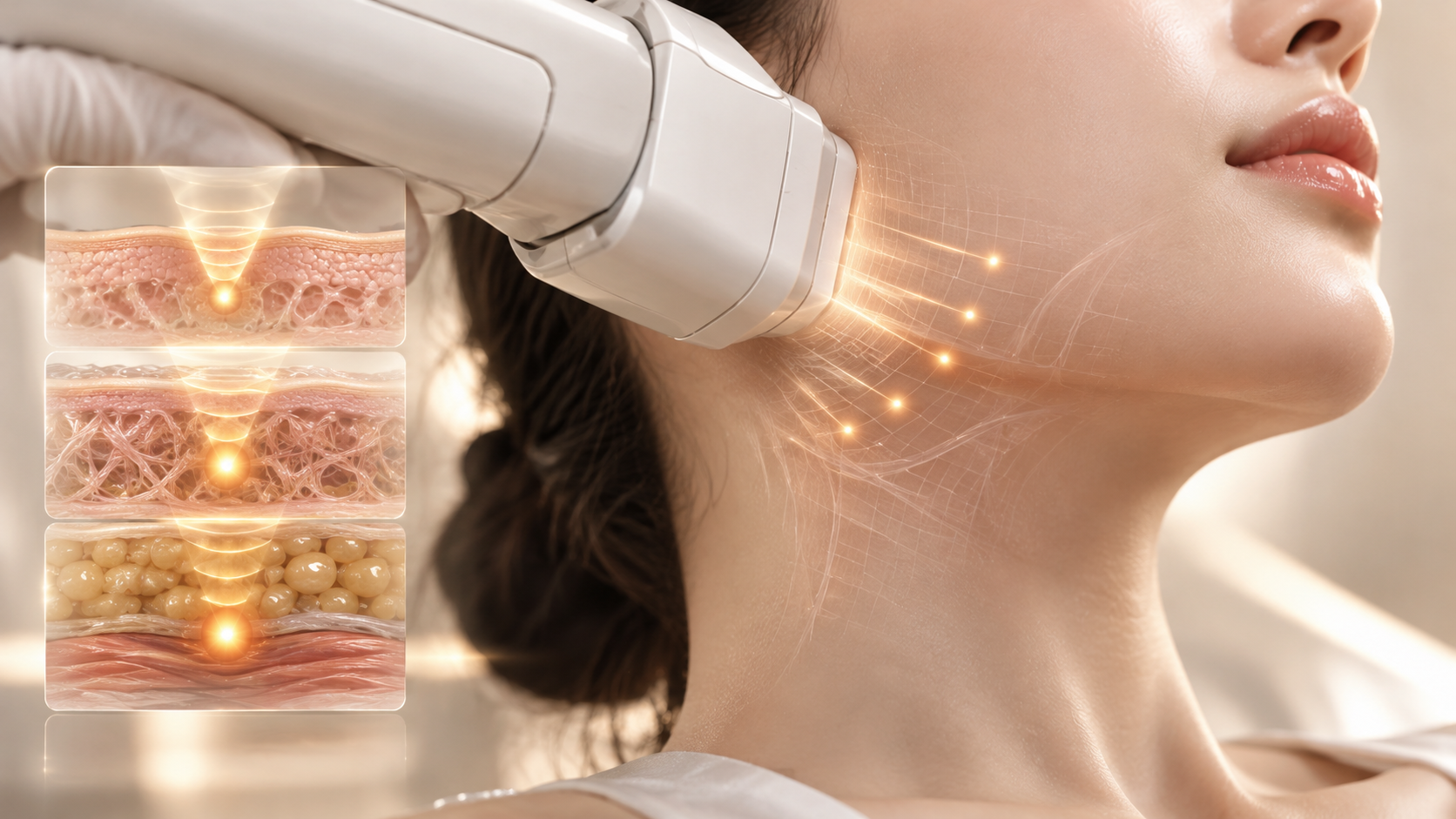
Ultherapy is a lifting device that delivers thermal energy to a set depth beneath the skin using micro-focused ultrasound (MFU). When ultrasound converges on one point, a small thermal coagulation point forms there, and this thermal stimulation is used to induce collagen denaturation and the remodeling process that follows.
The key is that it does not heat the entire skin surface but focuses ultrasound energy on tissue at the set depth. Ultherapy PRIME has an ultrasound imaging function that allows the tissue beneath the skin to be checked during the procedure, which is used as a reference in deciding where to send energy while looking at tissue thickness and target areas.
So when considering Ultherapy at an Apgujeong Rodeo Station dermatology clinic, it is important to check skin structure and target depth together rather than only counting shots.
What the depth numbers mean
Ultherapy PRIME typically uses transducers with depths of 1.5mm, 3.0mm, and 4.5mm. A transducer is the device that delivers ultrasound energy to skin tissue, and the tissue it reaches varies with the depth setting.
| Depth | Main target tissue |
|---|---|
| 1.5mm | Relatively shallow dermis, tissue related to skin elasticity |
| 3.0mm | Deep dermis and near the subcutaneous tissue |
| 4.5mm | Deep subcutaneous tissue and near the fascial layer (SMAS) |
The SMAS is a fibromuscular fascial tissue connected to the facial expression muscles and is related to the support structure that holds up the face.
There is an important point here. Just because 4.5mm is the deepest does not mean it suits every area or has a stronger lifting effect. The location of tissue differs by person and by area, and the same depth setting does not always reach the same anatomical layer. In Ultherapy PRIME consultations at our Apgujeong Rodeo Station dermatology clinic as well, the depth is chosen after understanding these differences.
Why depth is considered differently for each facial area
The face is covered by one continuous sheet of skin, but the structure beneath is quite complex. The skin around the eyes and temples is thin with relatively little fat, while tissue thickness around the cheeks and jaw varies greatly from person to person. This is why tissue responds differently in each area even when energy is sent to the same depth.
If loss of firmness in the cheeks is your concern, skin thickness and the amount of fat should be looked at together. If volume is lacking and too much energy goes into deep tissue, the possibility of unwanted fat loss or hollowing must also be considered.
For the jawline, it is necessary to distinguish whether loosened skin is the main cause or whether changes in fat or deep support tissue play a part. What matters in an Ultherapy procedure is choosing the depth and treatment range that fit the tissue structure of that area. When planning Ultherapy PRIME at our Apgujeong Rodeo Station dermatology clinic as well, we do not apply one standard to the whole face but examine the characteristics of each area separately.
How do pain and recovery progress?
While Ultherapy focuses ultrasound energy within the skin, you may feel warmth or a tingling pain. The degree of pain varies with the area, energy settings, and individual sensitivity, and discomfort may feel different in spots close to the bone.
After the procedure, there may be temporary redness, swelling, or tenderness to the touch, and in rare cases side effects such as burns, altered sensation, nerve injury, or fat atrophy may occur. Some people feel their skin tighten right after, but changes from collagen remodeling take time.
The progress is observed over weeks to months, and the degree of change and how long it lasts differ from person to person. If you are considering Ultherapy PRIME at an Apgujeong Rodeo Station dermatology clinic, check in advance your previous lifting history, current skin condition, and the expected recovery process.
What comes before depth: an accurate judgment
Ultherapy is a procedure that sends ultrasound energy to the tissue beneath the skin with transducers of different depths. But putting more energy deeper does not mean better results.
Each area differs in skin thickness, amount of fat, and location of support tissue, so the depth at which energy acts must be decided carefully. If you are considering Ultherapy at an Apgujeong Rodeo Station dermatology clinic, check your skin structure and the cause of sagging, and first understand the changes you can expect and the limitations. What matters with Ultherapy PRIME is not how deep it is applied but sending the right energy to the tissue that needs it.
Ultherapy frequently asked questions
How does Ultherapy PRIME work? It focuses micro-focused ultrasound at a specific depth beneath the skin to create thermal coagulation points, inducing a process in which collagen responds to heat and is rebuilt.
How do 1.5mm, 3.0mm, and 4.5mm differ? They are the target depths where ultrasound energy converges. They are chosen based on skin thickness and tissue structure, and deeper does not mean a greater effect.
Should the depth be changed for each area? Because skin thickness, fat distribution, and the location of support tissue differ by area, depths can be applied separately. The actual choice is made with reference to ultrasound imaging and the anatomical condition.
Can the cheeks become hollow after the procedure? In rare cases, fat atrophy or volume changes may occur. If there is little fat or volume is lacking, the treatment range and energy settings are reviewed more carefully.
When will I see results? Tissue response and collagen remodeling take time, so changes are seen over weeks to months. Timing and degree vary from person to person.
Author : Dr. Lee Young-hoon, Medical Director, RIOVE Clinic, Profile Last reviewed : 2026-11-15 This article contains general medical information. Treatment results and recovery vary from person to person, and side effects such as swelling, bruising, burns, fat atrophy, altered sensation, and nerve injury may occur. The actual scope of application and suitability are judged based on a physician's examination and the approved indications of the relevant product or device, and individual diagnosis and treatment plans are determined through an in-person consultation.
If a treatment interests you, we'll go over it together in the exam room
Whether a treatment is suitable, and how it is done, is decided after we check your individual condition. For more details, please call our main line.